Secondary glazing, laboratory testing and real retrofits
How Cavity Depth Changes Secondary Glazing Noise Reduction
A headline acoustic rating only becomes meaningful when the primary window, glass-to-glass cavity and complete laboratory arrangement are understood.
Secondary glazing is frequently promoted using a single laboratory sound-insulation figure. That number may be valid for the tested specimen, but it does not automatically describe the improvement that will be achieved when the system is fitted behind an existing openable window in a shallow domestic reveal.
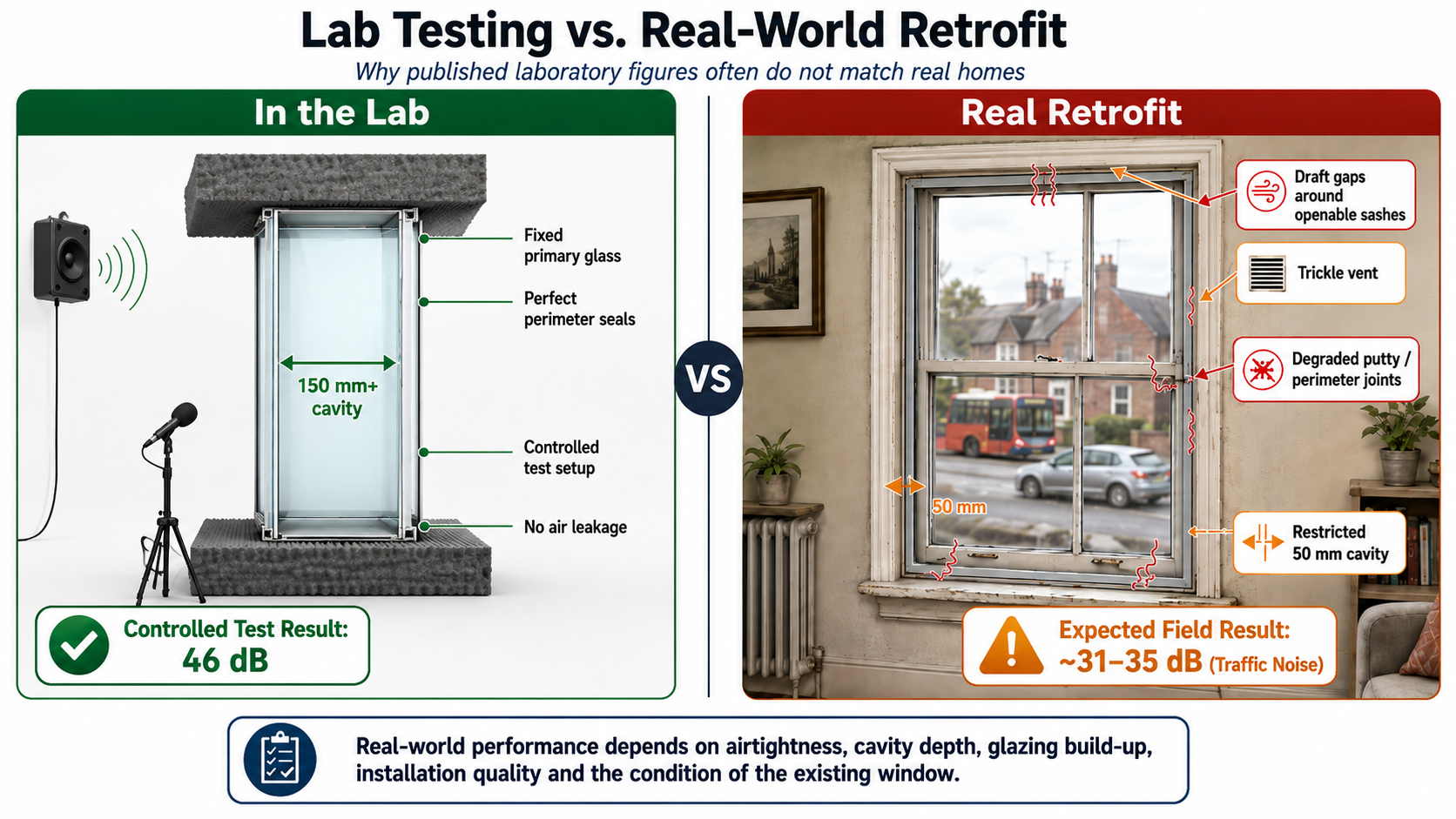
The result may describe a complete arrangement containing a fixed primary pane, a secondary window and a glass-to-glass cavity of 150 mm or 200 mm. In a retrofit, the available cavity may be closer to 50 mm, while the existing sash or casement may contain opening joints, hardware, vents or air leakage that were not present in the laboratory primary specimen.
The purpose of this guide is not to dismiss laboratory testing. Laboratory evidence is essential for comparing controlled specimens. The purpose is to show why the test arrangement must be compared with the proposed installation before a headline rating is used to set expectations.
How much does a shallow cavity affect secondary-glazing performance?
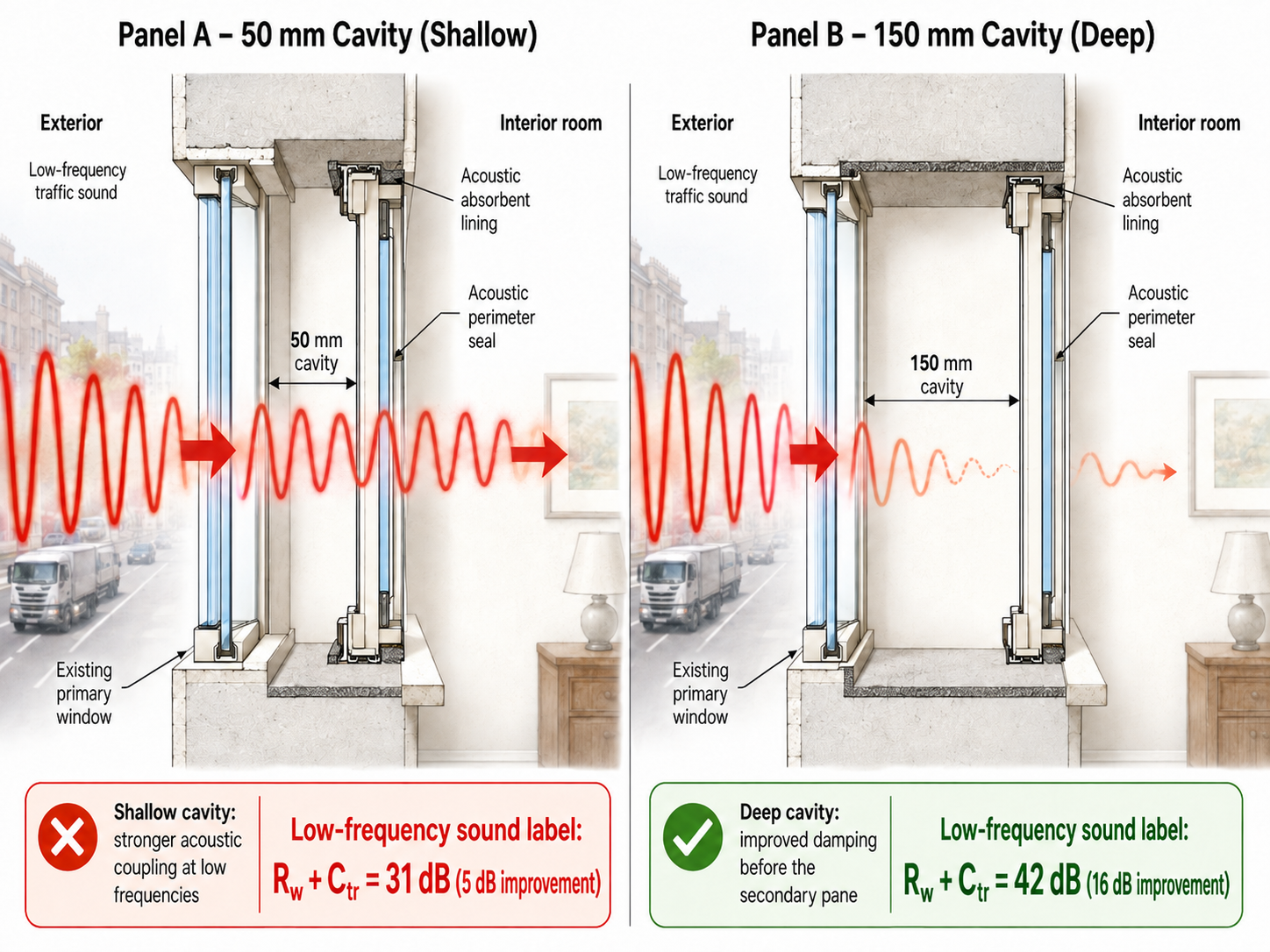
In the worked example used in this guide, reducing the glass-to-glass cavity from 150 mm to 50 mm changes the calculated combined rating from Rw 46 dB to Rw 40 dB. The difference in the traffic-spectrum result is larger: Rw + Ctr falls from 42 dB to 31 dB.
This is a reduction of 6 dB in Rw, but 11 dB in Rw + Ctr. The example therefore shows why a respectable headline Rw figure can conceal a much greater deterioration in the part of the spectrum relevant to many road, rail and other lower-frequency environmental noise sources.
At a glance
- Measure glass to glass: reveal depth, frame depth and glass-to-glass cavity are not the same measurement.
- Check the complete specimen: a published rating may describe the primary and secondary windows acting together.
- Combined does not mean additional: Rw 40 dB for the complete arrangement does not mean the secondary glazing adds 40 dB.
- Look beyond Rw: Ctr and the frequency-band data can reveal a larger loss at lower frequencies.
- The primary window matters: fixed laboratory glazing may not represent an older openable sash or casement.
- Field and laboratory values differ: an outside-to-inside site measurement is not automatically an Rw rating.
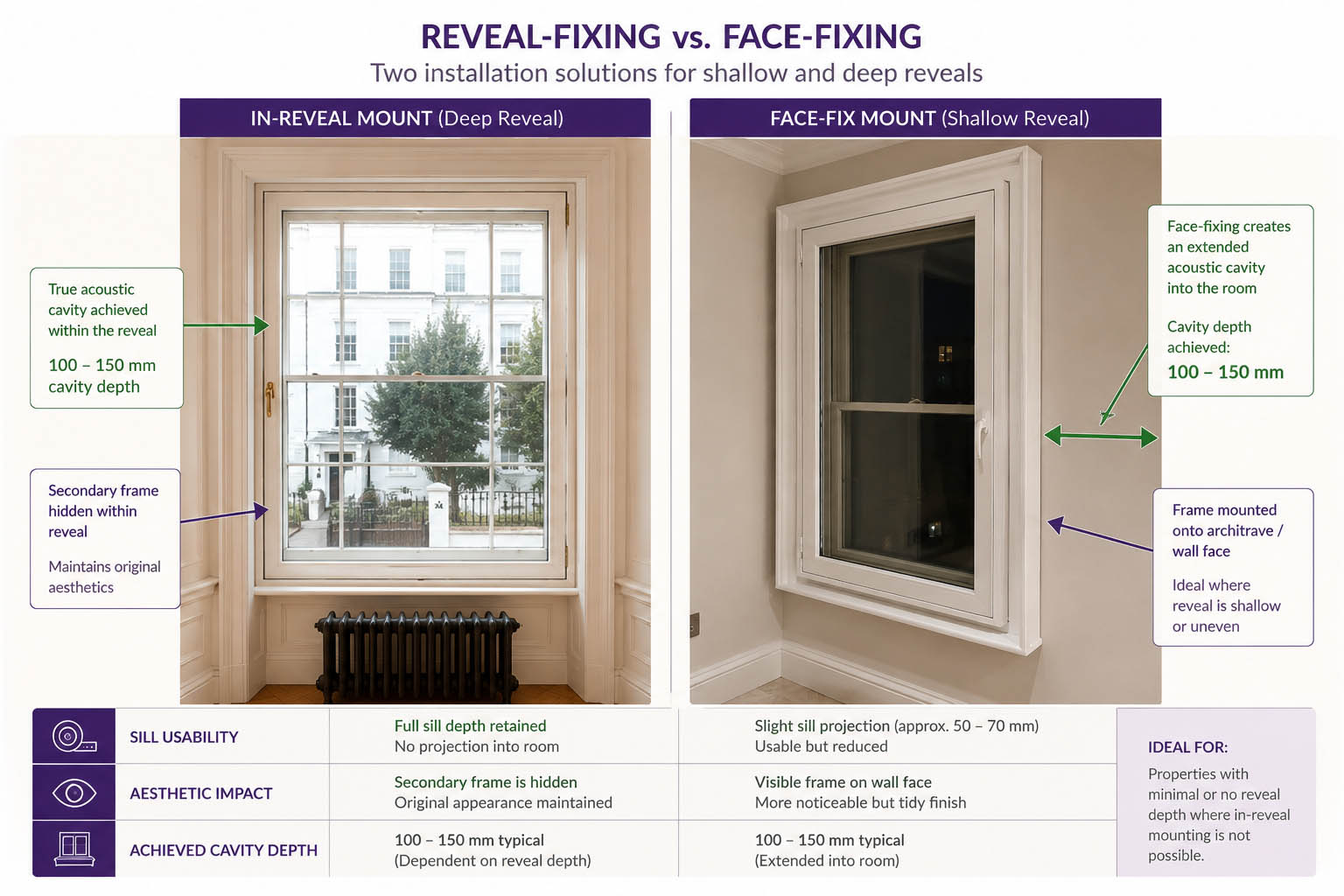
- Installation geometry matters: face-fixing can sometimes create more cavity where the reveal itself is shallow.
Why the test cavity matters
The same secondary-glazing arrangement can produce materially different calculated results when the glass-to-glass cavity is changed.
150 mm cavity
Rw 46 dB
Rw + Ctr 42 dB
100 mm cavity
Rw 43 dB
Rw + Ctr 38 dB
50 mm cavity
Rw 40 dB
Rw + Ctr 31 dB
In this worked example, reducing the cavity from 150 mm to 50 mm changes Rw by 6 dB but changes Rw + Ctr by 11 dB.
What Is the Glass-to-Glass Cavity?
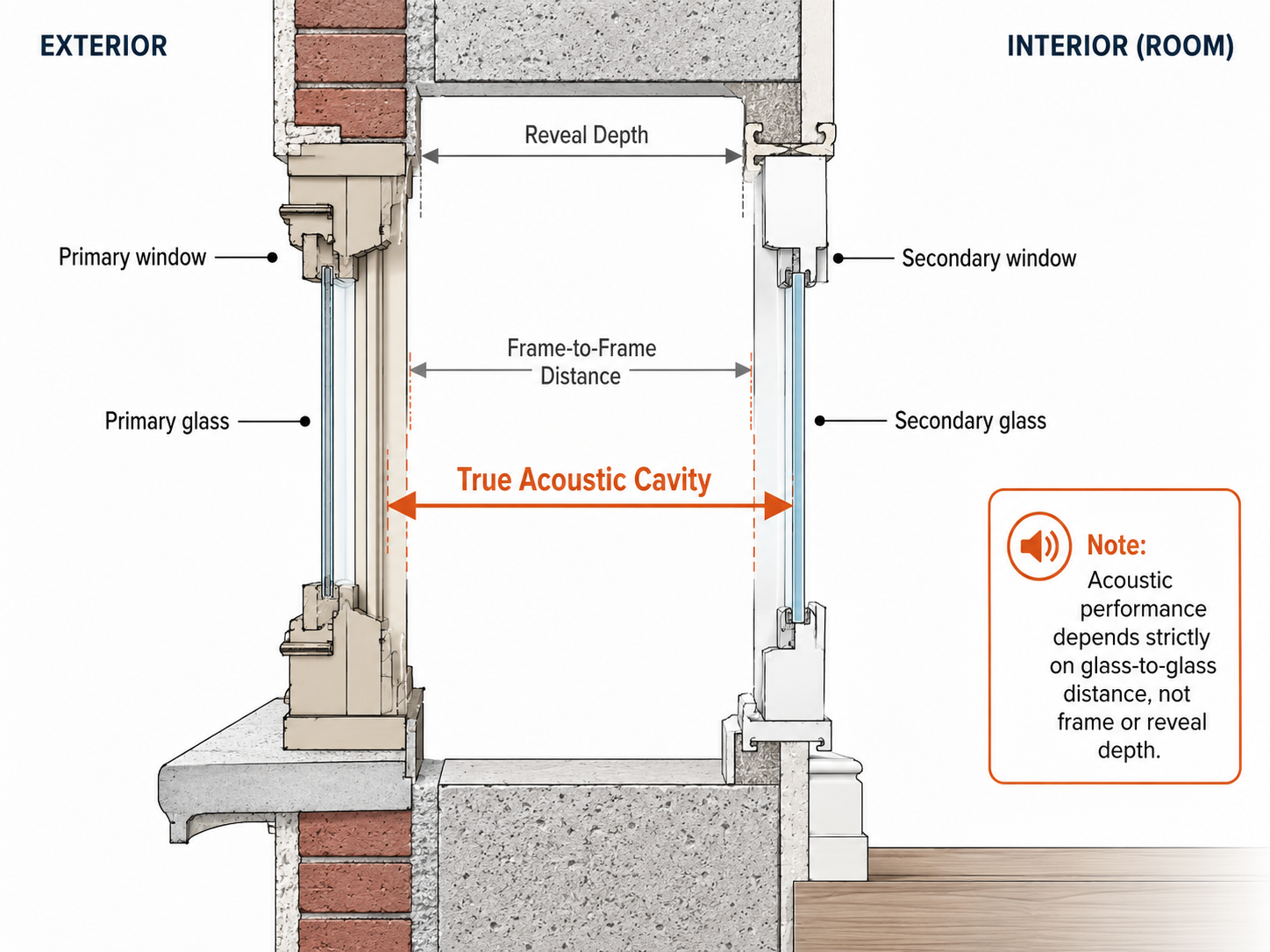
The relevant acoustic cavity is the clear distance between the internal face of the primary glass and the external face of the secondary glass.
Glass-to-glass cavity
The clear distance between the two glazing surfaces. This is the measurement that should be used when comparing a proposed installation with test data based on a stated air gap.
Reveal depth
The construction space available inside the window opening. A reveal may be shallow or absent even though a secondary frame can be positioned further into the room.
Frame-to-frame distance
The spacing between the primary and secondary frames. This can differ from the spacing between the panes because the glass is set within each frame.
Face-fix position
A secondary frame fixed to the internal wall face rather than entirely inside the reveal. This may increase the achievable glass-to-glass cavity, but it also changes appearance, sill use and room-side projection.
No usable reveal does not mean no cavity
A property may have no suitable reveal in which to recess the secondary frame. Once a face-fixed or room-side system is installed, however, there will still be a distance between the primary and secondary glass. The more accurate description is therefore “a shallow cavity or no usable reveal”, rather than “no cavity”.
What Is Included in a Secondary-Glazing Laboratory Result?
A secondary-glazing test result may relate to the complete combination of several elements rather than to the secondary pane or frame in isolation.
- The primary specimen: its glass thickness, dimensions, frame, mounting, seals and whether it is fixed or openable.
- The glass-to-glass cavity: the stated separation between the primary and secondary glazing.
- The secondary system: glass, frame, seals, opening arrangement, locks, meeting rails and installation perimeter.
- The test opening: specimen dimensions and the controlled laboratory wall into which it was mounted.
- The rating method: frequency-band measurements converted into Rw, C and Ctr values under the applicable test and rating standards.
If a report shows a combined result for a fixed 6 mm primary pane and a secondary sliding system separated by 150 mm, that result belongs to that complete arrangement. It should not be presented as though the secondary window alone will provide the same reduction behind every existing window.
Laboratory testing is not the problem
Controlled testing provides essential comparative evidence. The problem occurs when the test cavity, primary specimen or complete-system basis is omitted from the headline claim, or when a materially different retrofit is assumed to reproduce the laboratory number.
Combined Rating Versus the Improvement Added
A combined acoustic rating and an incremental improvement answer different questions.
| Arrangement | Rw | Ctr | Rw + Ctr |
|---|---|---|---|
| Laboratory primary window alone | 30 dB | −4 dB | 26 dB |
| Primary plus secondary system at 50 mm | 40 dB | −9 dB | 31 dB |
| Difference between the stated values | approximately +10 dB | Not treated as a separate improvement value | approximately +5 dB |
The complete arrangement is rated at Rw 40 dB, but the comparison does not show 40 dB of additional reduction created by the secondary glazing. Against the stated primary rating, the headline Rw difference is approximately 10 dB, while the Rw + Ctr difference is approximately 5 dB.
Why the Ctr column is not described as an “improvement”
Ctr is a spectrum adaptation term applied to Rw. It is normally shown as a negative number. The clearer comparison is between the resulting Rw + Ctr values, rather than describing the change in the adaptation term itself as a standalone noise reduction.
Worked Example: 50 mm, 100 mm and 150 mm Cavities
The following figures were calculated from supplied one-third-octave performance data and cavity-correction information for one sliding secondary-glazing arrangement.
| Glass-to-glass cavity | Calculated Rw | Ctr | Rw + Ctr | Difference from 150 mm |
|---|---|---|---|---|
| 50 mm | 40 dB | −9 dB | 31 dB | −6 dB Rw; −11 dB Rw + Ctr |
| 100 mm | 43 dB | −5 dB | 38 dB | −3 dB Rw; −4 dB Rw + Ctr |
| 150 mm | 46 dB | −4 dB | 42 dB | Reference arrangement |
These are calculated indicative values derived from the supplied spectrum and correction table. They are not independently certified ratings for every secondary-glazing system, window size or installation.
150 mm to 100 mm
Rw falls by approximately 3 dB and Rw + Ctr falls by approximately 4 dB. The change is measurable but the traffic-spectrum result remains relatively close to the 150 mm arrangement.
100 mm to 50 mm
Rw falls by a further 3 dB, while Rw + Ctr falls by approximately 7 dB. The shallower cavity has a disproportionately large effect on the traffic-spectrum rating.
150 mm to 50 mm
The complete change is 6 dB in Rw but 11 dB in Rw + Ctr. Looking only at Rw would understate the significance of the shallower arrangement.
What the example does not prove
It does not establish that every 50 mm cavity will achieve Rw 40 dB or that every 150 mm cavity will achieve Rw 46 dB. The figures belong to the supplied system data and calculation method.
Why Rw Alone Can Hide the Shallow-Cavity Problem
Rw
A single-number rating derived from the measured sound reduction across a defined frequency range. It is useful for summarising the overall laboratory performance of the tested specimen.
Ctr
A spectrum adaptation term that places greater emphasis on a spectrum containing more lower-frequency energy. It is often relevant when considering urban road traffic and certain other environmental sources.
Rw + Ctr
The Rw value after the Ctr adaptation has been applied. In the worked example, this value makes the lower-frequency deterioration associated with the 50 mm cavity much more visible.
Frequency spectrum
The underlying one-third-octave data shows where performance changes occur. It is more informative than a single number when the source contains difficult lower-frequency components.
Ctr is not a site-specific prediction for every car, bus, train, aircraft or music event. It is a standardised adaptation term. The actual result in a room will also depend on the source spectrum, distance, façade, ventilation, background noise and other transmission paths.
What Happens at Lower Frequencies?
The supplied correction data indicates that the greatest deterioration occurs towards the lower end of the measured spectrum.
| Frequency | 150 mm cavity | 100 mm cavity | 50 mm cavity | 150 mm to 50 mm change |
|---|---|---|---|---|
| 100 Hz | 27 dB | 21 dB | 13 dB | −14 dB |
| 125 Hz | 31 dB | 30 dB | 24 dB | −7 dB |
| 160 Hz | 36 dB | 32 dB | 26 dB | −10 dB |
| 200 Hz | 37 dB | 34 dB | 28 dB | −9 dB |
| 250 Hz | 40 dB | 37 dB | 32 dB | −8 dB |
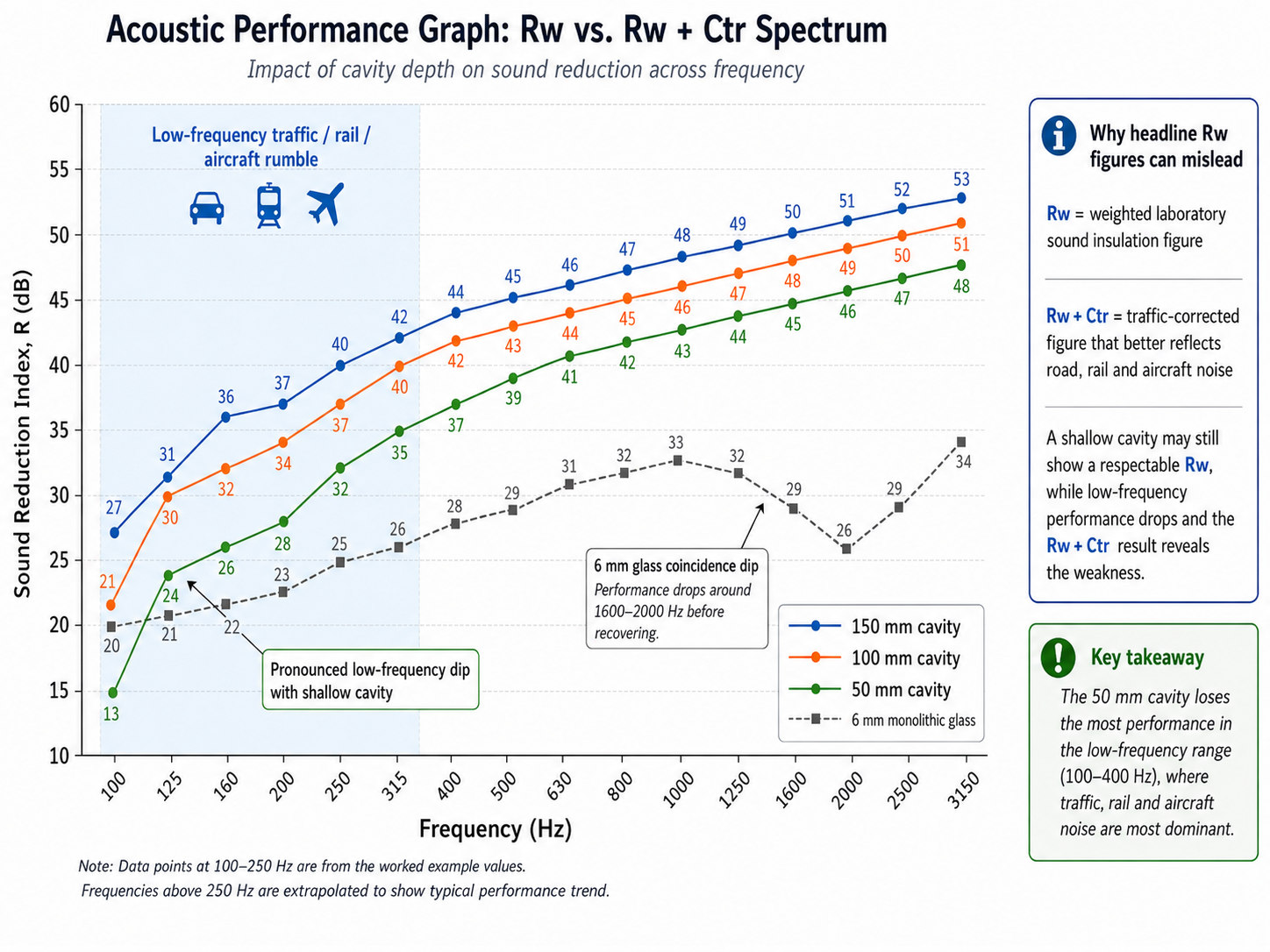
At 100 Hz, the calculated sound reduction changes from 27 dB at 150 mm to 13 dB at 50 mm. That is a 14 dB difference in this band, compared with a 6 dB difference between the final Rw ratings.
This is why the likely frequency content of the noise matters. Heavy vehicles, buses, motorcycles, rail events, aircraft and amplified music can all contain lower-frequency energy, but their spectra differ and should not be treated as identical.
Why the Primary Window Matters
The existing window is one part of the complete acoustic system. Its construction and airtightness can materially affect the combined result.
| Primary-window condition | Features to consider | Why it matters |
|---|---|---|
| Fixed laboratory pane | Known glass, controlled dimensions, fixed mounting and controlled perimeter | It may provide a more consistent and airtight primary layer than an older opening window. |
| Traditional openable sash | Meeting rails, staff and parting beads, sash-cord pockets, uneven closing and aged joints | Air leakage and multiple opening junctions can weaken the primary layer and alter the complete arrangement. |
| Openable casement | Seal continuity, hinge adjustment, locking pressure, frame condition and vents | The result depends on whether the opening sash closes evenly against effective seals. |
| Existing double glazing | Pane make-up, cavity, vents, seals, frame and opening configuration | “Double glazed” does not define one acoustic performance and should not be treated as a complete specification. |
A headline result based on a fixed 6 mm primary pane should therefore not be applied automatically to an existing openable sash. The primary window may be weaker, differently shaped and less airtight, and its frequency-dependent behaviour may differ from the laboratory specimen.
What Field Observations Can Show
In site observations reviewed for this guide, some existing openable windows have produced outside-to-inside level differences of only around 15–18 dB under the measured conditions. These observations help illustrate why an older opening window may not behave like a well-sealed fixed laboratory primary.
A site level difference is not automatically an Rw rating
The 15–18 dB observations should not be described as laboratory Rw values. An outside-to-inside field comparison may be affected by the external source, microphone positions, measurement periods, background sound, room absorption, façade area and other paths through the building.
Where numerical field evidence is published, the methodology should identify:
- the type and condition of the primary window;
- the noise source and measurement metric;
- whether external and internal measurements were simultaneous;
- microphone positions and measurement durations;
- background-noise limitations;
- whether frequency-band data was recorded;
- whether the result represents the complete façade or a window-dominated path;
- any relevant field test standard or departure from a standard method.
Field observations and laboratory ratings can complement one another, but they should not be given the same label or treated as directly interchangeable.
Why You Cannot Simply Subtract a Weaker Primary Rating
Suppose a complete laboratory arrangement achieves Rw 43 dB using a primary specimen rated at Rw 30 dB, while the existing openable window is believed to provide around Rw 20 dB. It may be tempting to subtract 10 dB and predict a combined result of Rw 33 dB.
That arithmetic is not a reliable prediction. The interaction between the two layers depends on more than the difference between their single-number ratings.
Frequency-dependent behaviour
Two primary windows with different Rw values may have very different strengths and weaknesses across the frequency spectrum.
Air leakage
Gaps and opening joints can affect performance differently from transmission through the glass and frame surfaces.
Mass and resonance
Glass thicknesses, pane asymmetry, cavity depth and dimensions affect the resonant behaviour of the combined system.
Frames and junctions
The secondary frame, meeting rails, locks, perimeter installation and primary-frame condition all form part of the result.
A weaker or leakier primary window is likely to reduce the combined performance, but a 10 dB difference in the primary rating does not necessarily create an equal 10 dB difference in the complete secondary-glazing result.
Shallow Cavity or No Usable Reveal: What Are the Options?
A shallow domestic reveal does not always mean that secondary glazing is impossible, but it may restrict the installation position and prevent the proposed arrangement from matching the cavity used in a headline test.
| Possible response | Potential benefit | Important limitation |
|---|---|---|
| Face-fix the secondary frame | Can position the secondary glass further into the room and increase the glass-to-glass cavity. | Affects appearance, sill depth, curtains, blinds, shutters, handles and room-side projection. |
| Use a system designed for restricted depth | May provide stronger seals, suitable glass and an opening arrangement intended for shallow retrofit conditions. | A product description does not replace evidence for the proposed complete arrangement. |
| Repair or improve the primary window | Can reduce leakage through joints and improve the starting condition of the combined system. | Repairs may not address weak glass, vents, frame movement or other façade paths. |
| Change the opening arrangement | A hinged or compression-sealed system may provide a different balance of access, seals and acoustic performance. | The selected system still needs to fit the available geometry and required operation. |
| Consider replacement glazing or windows | May remove the need to work around a very weak primary window where alteration is permitted. | Appearance, planning, conservation, cost and the achievable complete-window rating must be assessed. |
| Investigate other transmission paths | Can identify vents, doors, walls, roof structures or junctions that may limit the benefit of window work. | A stronger window will not control noise bypassing it through another significant path. |
For more detail on specialist timber secondary systems, reveal-fit and face-fix arrangements, see secondary glazing designed around sash windows and restricted reveals. This is a commercial resource operated by The Soundproof Windows.
How to Compare Secondary-Glazing Claims
Before comparing two headline ratings, ask for enough information to establish whether they describe comparable arrangements.
- What was the glass-to-glass cavity? Confirm the test spacing rather than relying on a general reference to frame or reveal depth.
- What primary window was used? Ask for its glass, frame, dimensions and standalone acoustic rating.
- Was the primary fixed or openable? A fixed pane may not represent an opening sash or casement.
- Is the number combined or secondary-only? Establish whether the rating belongs to the complete primary-plus-secondary arrangement.
- Is the figure Rw, Rw + C or Rw + Ctr? These are not interchangeable descriptions.
- Is frequency-band data available? This can show weaknesses hidden by a single-number rating.
- Was the result measured or calculated? Predictions, interpolation and cavity corrections should be labelled clearly.
- Were vents present? A test without ventilation openings may not represent an installation containing an acoustic vent or trickle vent.
- Does the proposed installation match the test? Compare the cavity, size, opening arrangement, glass, seals and fixing position.
- Is the laboratory number being presented as a room reduction? A complete-window laboratory rating is not a guaranteed reduction in an occupied room.
The most useful question
Ask: “What complete arrangement produced this figure, and how closely will my proposed installation reproduce it?”
Other Factors That Can Limit the Installed Result
Cavity depth and the primary window are important, but they are not the only variables.
Secondary-frame airtightness
Opening joints, meeting rails and perimeter seals must control air leakage when the unit is closed.
Installation perimeter
Gaps between the new frame and the building can create bypass paths if the junction is not detailed and sealed correctly.
Ventilation openings
Trickle vents, air bricks and other ventilation routes can limit façade performance and must not be blocked without considering ventilation requirements.
Surrounding construction
Walls, lightweight panels, roofs, floors, doors and façade junctions may become controlling paths after the windows are improved.
Room background level
A very quiet room can make remaining events more noticeable, while a high internal background level can limit what a field measurement can demonstrate.
Noise-source spectrum
Two sources with the same overall external level can produce different internal outcomes because their frequency content and event patterns differ.
For a broader explanation of complete-window evidence and specification, read how to specify soundproof windows and doors. For an introduction to the wider façade problem, see soundproof windows and acoustic glazing explained.
Frequently Asked Questions
Is a 50 mm cavity enough for secondary glazing?
A 50 mm cavity can still provide an improvement, but it should not be assumed to reproduce a result obtained at 150 mm or 200 mm. In the worked example on this page, the 50 mm arrangement calculates to Rw 40 dB and Rw + Ctr 31 dB, compared with Rw 46 dB and Rw + Ctr 42 dB at 150 mm.
Does a larger secondary-glazing air gap always perform better?
Increasing a very shallow cavity can improve performance, particularly at lower frequencies, but the relationship is not unlimited or perfectly linear. The glass, primary window, frame, seals, dimensions and complete system still matter.
What is the correct way to measure the cavity?
Measure the clear distance from the internal face of the primary glass to the external face of the secondary glass. Reveal depth and frame-to-frame distance may not equal the glass-to-glass cavity.
Does Rw 40 dB mean the secondary glazing reduces noise by 40 dB?
Not necessarily. The figure may describe the complete primary-plus-secondary laboratory arrangement. If the primary window already achieved Rw 30 dB, the combined Rw 40 dB figure represents an approximate 10 dB difference between those stated ratings, not 40 dB of additional improvement.
Why is Rw + Ctr lower than Rw?
Ctr is normally a negative spectrum adaptation term. It adjusts Rw for a spectrum containing more lower-frequency energy. A strongly negative Ctr can reveal lower-frequency weaknesses that are less obvious from Rw alone.
Can I subtract the difference between two primary-window ratings?
No reliable combined rating can be produced through simple subtraction. Frequency response, leakage, pane mass, cavity resonance, dimensions, frames, seals and installation junctions all influence the interaction between the two windows.
Is a fixed 6 mm laboratory pane representative of an openable sash?
Not automatically. An openable sash contains meeting rails, moving joints, hardware and possible leakage paths that may not be present in a controlled fixed specimen. The test arrangement and the proposed installation should be compared directly.
Are field measurements the same as an Rw laboratory rating?
No. A site comparison may measure an outside-to-inside level difference under particular source and room conditions. Rw is a laboratory single-number rating derived from frequency-band measurements of a controlled specimen. The quantities should be labelled accurately.
Can face-fixing create a larger cavity?
Sometimes. Positioning the secondary frame on the internal wall face can move the secondary glass further from the primary pane. The detail must still account for appearance, sill use, curtains, blinds, shutters, handles, access and the perimeter installation.
Technical References and Evidence Notes
- BS EN ISO 10140 series: laboratory measurement of sound insulation of building elements.
- BS EN ISO 717-1: rating of airborne sound insulation in buildings and of building elements.
- Worked-example spectrum: supplied sliding-system one-third-octave values for the 150 mm arrangement.
- Cavity corrections: supplied correction values used to estimate the 50 mm and 100 mm spectra.
- Calculated ratings: Rw and Ctr derived from the supplied spectrum for explanatory comparison.
- Field observations: site-specific outside-to-inside level differences, not laboratory Rw ratings.
Technical limitation
The worked figures illustrate how cavity depth may affect one supplied secondary-glazing arrangement. They do not guarantee the result in a particular property. Actual performance depends on the existing window, cavity, secondary system, dimensions, airtightness, installation, ventilation, source spectrum, receiving room and surrounding building fabric.
Technically reviewed by Sebastian Paszek
Environmental Noise Measurement and Building Acoustics Specialist
Sebastian Paszek holds the Institute of Acoustics Certificate of Competence in Environmental Noise Measurement. His technical experience includes site noise diagnostic surveys, environmental noise measurement, floor impact sound insulation testing, investigation of noise transmission in domestic properties, structural acoustic analysis for domestic properties, and acoustic assessment of windows, glazing and building openings.